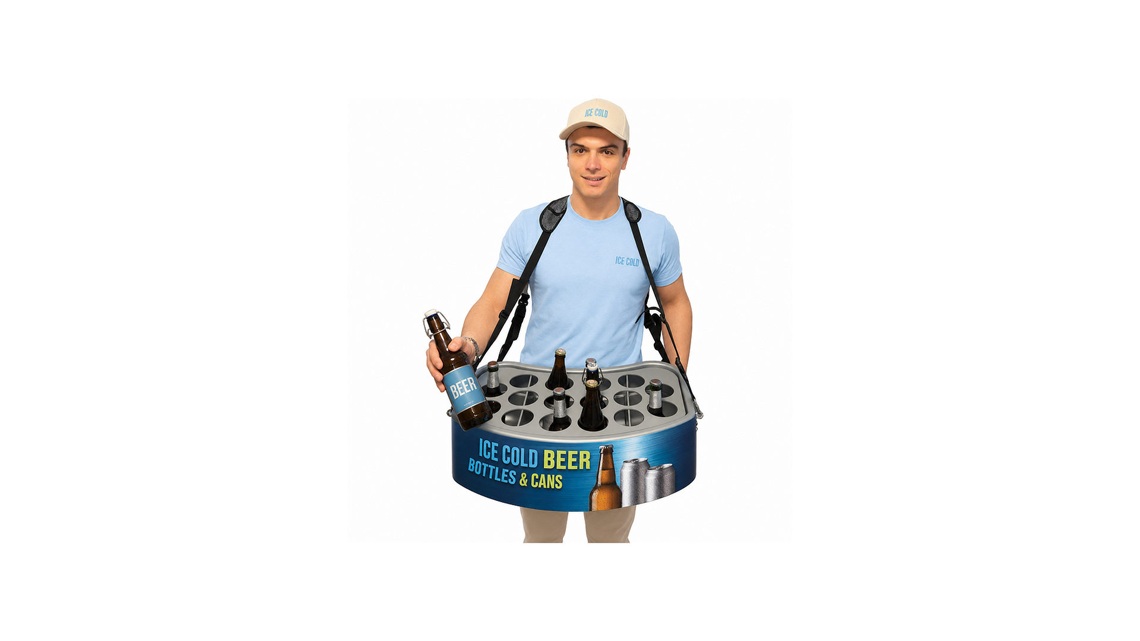
Driving Mobile Coffee Success Global Capitals
- The coffee hawker backpack is your go-to for mobile coffee service!
- Ideal for events, festivals, and outdoor gatherings.
- Serve fresh coffee wherever you are.
Frequently Asked Questions About Coffee Hawker Backpacks
A coffee hawker backpack allows trained staff to carry prepared coffee and serve it directly to visitors within an approved event area. A successful mobile service depends on suitable beverages, clearly assigned routes, safe handling of hot drinks and an organized refill station. The following answers help event organizers, caterers and promotional teams prepare the complete operating process.
What is a coffee hawker backpack?
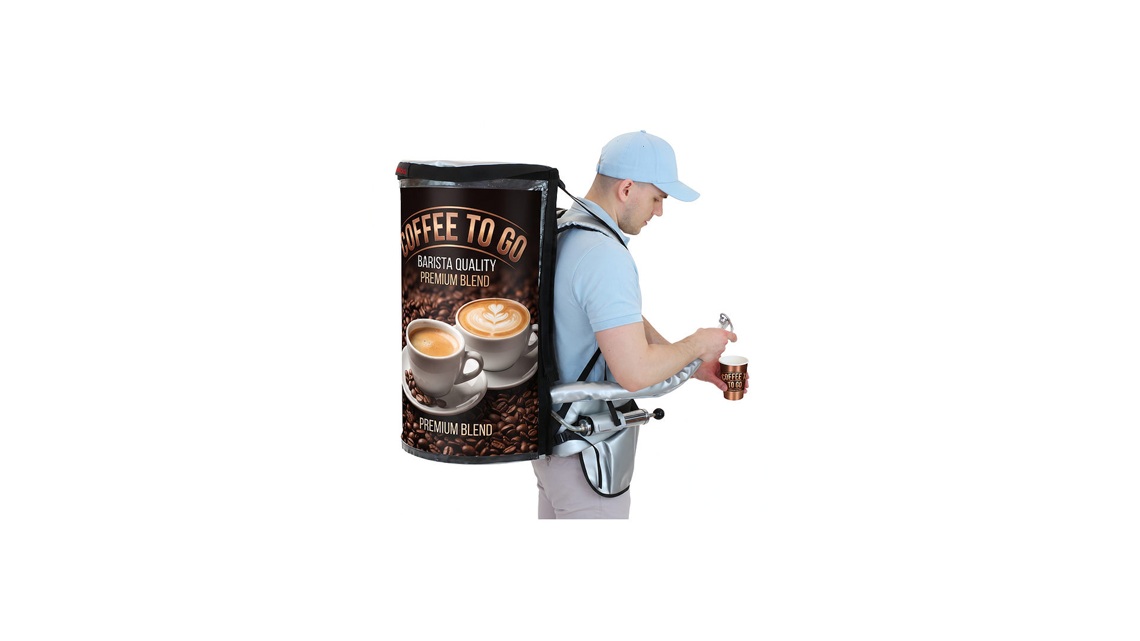
A coffee hawker backpack is a wearable beverage dispensing system used by a mobile seller or service employee. Prepared coffee is carried in an insulated container and dispensed through a beverage hose and hand-operated tap.
The operator can approach visitors instead of serving exclusively from a fixed coffee counter.
What does the term coffee hawker mean?
A coffee hawker is a mobile vendor who moves through an assigned area and offers coffee directly to visitors. Depending on the event concept, the operator may sell drinks, distribute samples or provide complimentary hospitality service.
The backpack is the dispensing equipment. Staffing, payment collection and operation of the service remain the responsibility of the event organizer or catering company.
What does the coffee hawker backpack video demonstrate?
The video illustrates the visible part of mobile coffee service. It provides an impression of how the backpack is carried, how the tap is handled and how an operator can serve customers away from a permanent beverage station.
The footage is an application example. The required model, capacity and accessories must be selected according to the actual beverage and venue.
Is coffee prepared inside the hawker backpack?
No. The backpack does not grind beans, brew coffee or heat water. The finished beverage must be prepared and filtered at a separate coffee or refill station.
The backpack is used to transport and dispense the prepared drink.
Where can a coffee hawker be deployed?
Mobile coffee service can be useful where visitors are distributed across a larger area or where a temporary coffee counter would be impractical.
- Trade fairs and exhibitions
- Conferences and corporate events
- Festivals and outdoor gatherings
- Hospitality and reception areas
- Promotional campaigns
- Queues and designated waiting zones
- Sports and spectator events
- Film sets and production locations
The venue operator must approve the serving zones and ensure that mobile staff do not obstruct entrances, emergency routes or other visitors.
Can the backpack replace a conventional coffee station?
The system is generally most practical as an extension of a fixed preparation area. Coffee still needs to be brewed, stored, refilled and handled hygienically at a suitable station.
Mobile staff can then carry the prepared drink into selected event areas while the fixed station manages beverage preparation and supplies.
How should a mobile sales area be selected?
The operator needs enough space to walk, stop and serve safely. Suitable areas should provide clear walking routes and convenient access to the refill station.
Narrow stairways, emergency exits, confined passages and locations with uncontrolled crowd movement should not be included in the route.
Should each coffee hawker receive a defined route?
Yes. Assigning a specific zone or walking route helps prevent several operators from covering the same area while other sections remain unattended.
A defined route also makes it easier to plan refill intervals, staff supervision and communication with the preparation station.
How can mobile coffee service be coordinated with a fixed counter?
The mobile and stationary teams should follow one operating plan. Responsibilities for brewing, filling, cup supplies, cleaning and stock control should be assigned before the event begins.
The hawker should know where to return for refilling and who is responsible for inspecting the system before it is issued again.
How many coffee hawkers are required for an event?
The required number depends on the size and layout of the venue rather than only on the total number of visitors. Serving size, walking distance, refill time and expected demand must also be considered.
A trial with a limited number of systems can help establish realistic routes and refill cycles before a larger deployment is planned.
How should the coffee be prepared for mobile service?
The beverage should be completely brewed, filtered and mixed before it is filled into the backpack container. Grounds, undissolved powder and other solid ingredients must not enter the beverage path.
For hot coffee in a stainless-steel container, the clean vessel can be preheated with hot water. The preheating water must be emptied before the coffee is added.
Does the coffee hawker backpack actively heat the beverage?
No. The backpack is insulated but does not contain an active heating system. Coffee must reach the required serving temperature before the container is filled.
The insulation slows down temperature loss. The actual result depends on the model, initial temperature, filling quantity, ambient conditions and service duration.
Does the operator need an electrical connection?
A suitable gravity-fed configuration for still coffee does not require electricity while the operator is serving customers.
Separate electrical equipment may still be needed at the preparation station for brewing coffee, heating water or storing other ingredients.
Which coffee drinks can be served?
The system is intended for prepared beverages that are sufficiently fluid to pass through the container outlet, hose and tap. Filter coffee, Americano, decaffeinated coffee, tea and selected cold coffee drinks may be suitable.
The exact recipe should be assessed when it contains milk, syrup, chocolate, spices or other ingredients that alter the consistency.
Can milk-based coffee be carried by a coffee hawker?
A sufficiently fluid prepared coffee-and-milk beverage may be technically dispensable. However, dairy products require controlled temperature management and particularly thorough cleaning.
The event or catering operator is responsible for establishing an appropriate food-hygiene procedure for preparation, service and cleaning.
Can milk and sugar be added separately?
Yes. Serving black coffee from the backpack and offering milk, sugar or sweetener separately can simplify beverage handling and allow customers to adjust their drink.
Additional ingredients can be provided at a fixed station, carried by another employee or organized in suitable service accessories.
Can a coffee hawker serve hot chocolate or chai?
This depends on the finished consistency. A thin and completely dissolved beverage may flow through a suitable system, while thick mixtures or drinks containing sediment can restrict the hose or tap.
The intended recipe should be tested with the selected equipment before it is used during an event.
How should the backpack be filled safely?
The backpack must be removed from the operator and placed securely on a stable surface. Hot coffee should never be poured into the container while the system is being worn.
A clean jug or suitable funnel can be used to transfer the beverage without contaminating the container opening or external fittings.
What should a coffee refill station provide?
The refill station should be located away from visitor traffic and provide sufficient space for safe preparation.
- Freshly prepared coffee
- A stable surface for the backpack
- Clean jugs or filling accessories
- Cups, lids and service materials
- Cleaning and wiping supplies
- Space for checking the hose and tap
The system should be inspected before it is returned to the mobile operator.
How can the remaining coffee quantity be monitored?
The operator should become familiar with the approximate number of servings available from the selected filling quantity. Consumption can also be recorded each time the backpack is issued or refilled.
The theoretical number of portions should allow for test dispensing, incomplete servings and beverage remaining inside the container and hose.
How should refill intervals be planned?
Refilling should take place before the coffee supply or cup stock is completely exhausted. The interval depends on the filling quantity, serving size, customer demand and distance to the preparation station.
A clear communication method between the mobile operator and refill team helps reduce unnecessary service interruptions.
Can a second prepared backpack reduce waiting time?
A replacement unit may be useful when one backpack is being refilled, cleaned or assigned to another employee. This depends on the size of the event and the expected beverage demand.
A prepared replacement should still be inspected and tested before it is issued.
How should the backpack fit the coffee hawker?
The shoulder straps and waist belt must be adjusted to the individual wearer. The filled backpack should sit close to the body and remain stable during walking and dispensing.
The adjustment should be tested with the intended filling quantity because the operating weight influences carrying comfort and balance.
Who is suitable for working as a coffee hawker?
The operator must be physically able to carry the selected system and move safely through the assigned area. Capacity, walking distance and duration of the service period should be matched to the employee.
Regular breaks or changes of operator may be appropriate during longer assignments.
What training should mobile coffee staff receive?
Operators should practise with the actual backpack, beverage and cups before serving visitors.
- Adjusting the carrying straps
- Putting on and removing the filled backpack
- Walking and turning safely
- Opening and closing the tap
- Securing the tap between servings
- Recognizing leaks or restricted flow
- Returning safely to the refill station
- Following hygiene procedures
The video can provide an introduction but does not replace practical training.
Should the hawker dispense coffee while moving?
No. The operator should stop in a stable position before opening the tap. This provides better control over the hot beverage and reduces the risk of spilling.
The serving position should also leave enough space for the customer to receive the cup safely.
How should the tap be carried between customers?
The tap should be returned to its intended holder or carrying position after each serving. It should not swing freely or touch clothing, floors or surrounding objects.
The beverage hose should be arranged so that it does not become kinked or catch on barriers and furniture.
How can the risk of burns be reduced?
Hot beverage handling requires controlled filling, secure connections and trained staff. The operator should inspect the tap and hose before entering the visitor area and stop service immediately if leakage occurs.
Cups must be suitable for hot drinks, and the customer should receive the filled cup in a stable position.
Which cups can be carried with the backpack?
A compatible universal cup dispenser can hold many disposable or reusable cups with capacities from approximately 100 to 550 millilitres and rim diameters between approximately 60 and 95 millimetres.
Cups with handles, unusual rims or strongly tapered shapes should be tested before the event.
Where can lids and stirrers be stored?
Lids and stirrers are not automatically accommodated inside the cup dispenser. They can be organized in an apron, separate holder or at a fixed service point.
The selected storage position must not interfere with the tap, hose or carrying straps.
Can reusable cups be used by a mobile seller?
Reusable cups may be suitable when their dimensions and shape match the serving process. A sample should be checked before a larger number is ordered.
The organizer must also plan how used cups will be returned, collected and cleaned.
Can the coffee hawker collect payment?
The backpack does not include a standard payment system. The operator can use a separate card terminal, cash solution, voucher system or other method selected by the event organizer.
Payment equipment should be positioned so that it does not obstruct the beverage hose, tap or cup supply.
Can the backpack be used for complimentary coffee service?
Yes. The system can be used for paid sales, guest hospitality or free product distribution. The operating procedure should make clear whether payment, vouchers or registration are required.
Removing payment from the serving process may shorten the interaction, but the practical result still depends on portion size and venue layout.
Can the system be used for coffee samples?
Yes. Small tasting cups can be served during product launches, trade fairs and promotional campaigns.
The organizer should calculate the likely number of samples using the actual filling quantity and cup volume while allowing for test pours and operational losses.
Does a coffee hawker guarantee increased sales?
No. Mobile service enables direct customer contact and makes coffee available away from a fixed counter, but it cannot guarantee a particular commercial result.
Performance also depends on the beverage, location, demand, staff, pricing and overall event concept.
Can the operator provide product information while serving?
Yes. Mobile staff can explain the coffee, origin, roast, recipe or campaign when this forms part of the event concept.
Product training should remain concise enough that the operator can serve visitors safely without creating congestion.
Can branding be displayed on a coffee hawker backpack?
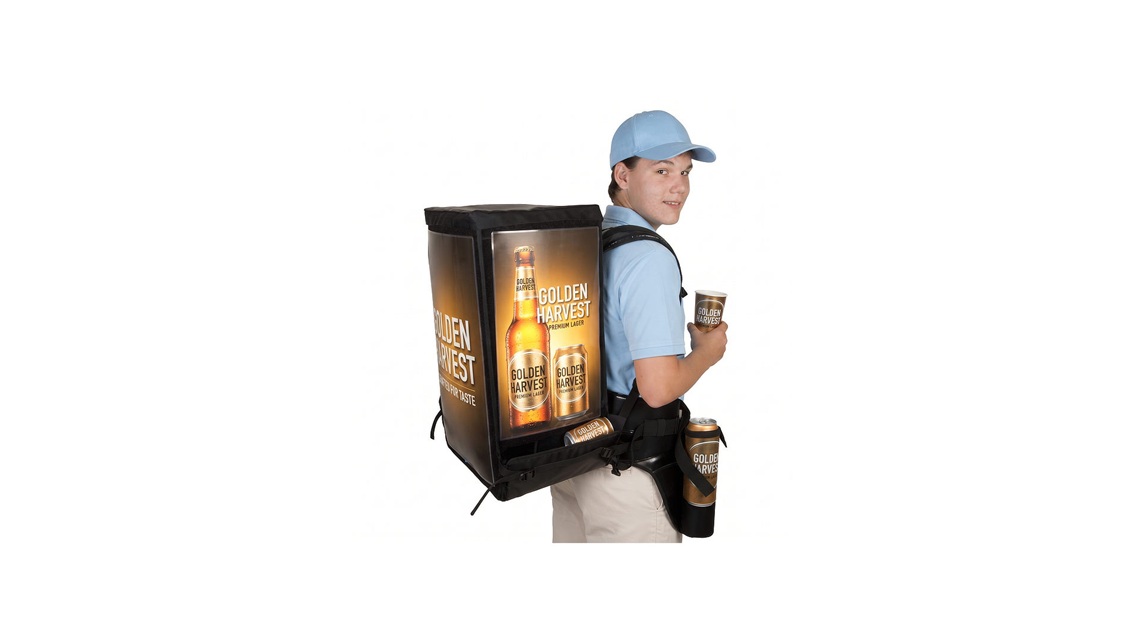
Depending on the selected model, printed paper graphics can be inserted into transparent display areas. These may show the coffee brand, sponsor, campaign message or beverage identification.
The dimensions differ between models and should be confirmed before artwork is prepared. Printing and graphic design are not automatically included.
Can prices be shown on the backpack?
Suitable poster areas may be used for clearly presented price or product information. The text should remain readable while the operator is moving.
The organizer is responsible for checking any local requirements concerning price display, ingredients or allergen information.
What should be done if the coffee flow becomes slow?
The operator should return the backpack to the refill station for inspection. Possible causes include a kinked hose, residue inside the tap, a low beverage level or an incorrectly positioned container.
Additional pressure should not be applied to a gravity-fed configuration unless the system is specifically designed for it.
What should happen if coffee leaks from the system?
Service must stop immediately. The backpack should be removed from the visitor area and placed securely before the hose, tap and container closure are inspected.
The system should not be used again until the cause of the leak has been identified and corrected.
Can another employee take over the backpack?
Yes. The replacement operator must be trained, and the shoulder straps and waist belt must be adjusted to the new wearer.
The handover should also include information about the beverage, remaining quantity, assigned route and next planned refill.
How should the system be cleaned after coffee service?
Remaining coffee should be emptied before residue can dry. The container, outlet, hose and tap must be rinsed so that the complete beverage path is treated.
A suitable beverage-system cleaning product can be used according to its instructions. Afterwards, rinse thoroughly with clean water and allow the components to drain and dry.
Does cleaning only the container remove all coffee residue?
No. Coffee also contacts the hose, connectors and internal passages of the dispensing tap.
The cleaning solution and rinse water must pass through all beverage-contacting components.
What requires special attention after sweetened or milk-based coffee?
Sugar, syrup and dairy residues can adhere to internal surfaces and should be removed promptly. Milk-containing beverages require a particularly careful hygiene procedure.
The system must not be stored or filled with another beverage until the complete liquid path has been cleaned properly.
What information is needed for a coffee hawker backpack quotation?
Please describe the planned mobile service and provide the relevant project details:
- Required number of backpacks
- Type and ingredients of the coffee beverage
- Hot or cold service
- Preferred filling capacity
- Serving or sample cup size
- Cup rim diameter and shape
- Paid sale, hospitality or sampling use
- Indoor or outdoor venue
- Expected duration of each service period
- Distance to the refill station
- Required accessories and advertising areas
- Event date or requested delivery date
- Delivery country and postal code
If the operating concept has not yet been finalized, describe the event layout, expected demand and available coffee preparation facilities. This information helps identify a suitable available configuration.
We believe in fostering a community of coffee lovers who share a passion for adventure and quality. Join us in redefining your coffee journey with the ultimate Backpack. Follow us on social media and share your experiences with our growing community.